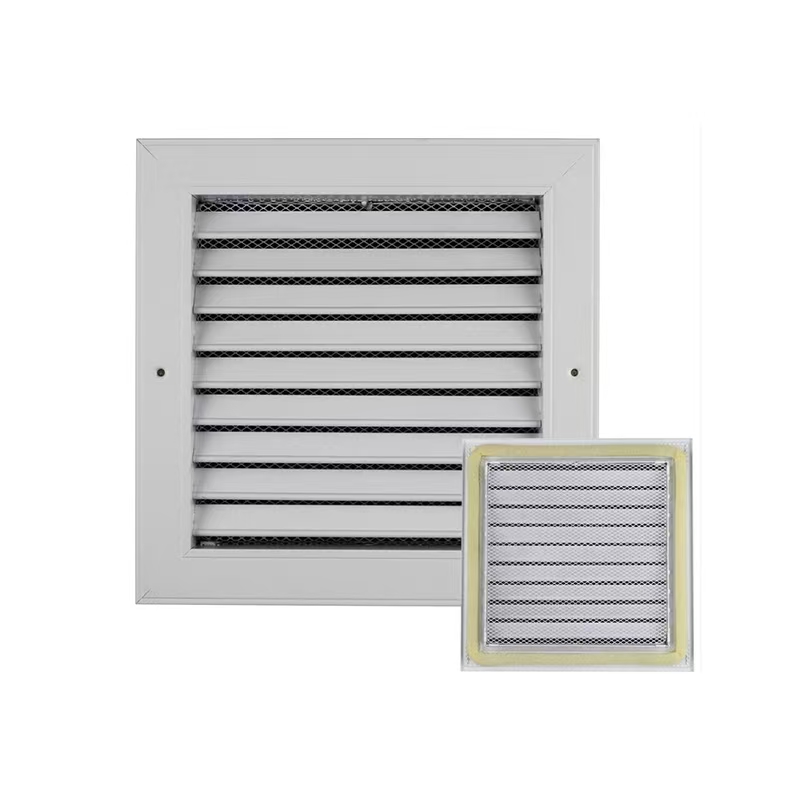
With the advancement of global carbon neutrality goals and the iteration of domestic industry standards, the HVAC industry is ushering in a transition period centered on "compliance upgrading, scenario adaptation, and circular sustainability". As the key carrier of system performance, HVAC Components see their technological R&D and product iteration increasingly aligned with the needs of segmented scenarios.
Core components such as Louver, Ventilation Fan, Dehumidifier, Fire Damper, and Draught Fan have achieved dual breakthroughs in compliance and functionality driven by new national standards, AI computing infrastructure, medical cleanliness, and other fields, laying a solid foundation for the high-quality development of the industry.
The field of fire safety is undergoing comprehensive upgrading under the constraints of strict standards, with Fire Damper becoming the core focus of compliance renovation. The new national standard GB15930—2024 "Fire Dampers for Building Ventilation and Smoke Exhaust Systems", officially implemented on March 1, 2026, not only adds definitions of categories such as normally closed air supply valves and automatic smoke exhaust windows but also strengthens requirements for the fire resistance rating, remote reset, and signal feedback functions of fire dampers, incorporating the fire resistance test of fire dampers with a rated operating temperature of 150℃ into mandatory standards. To meet the new requirements, industry enterprises have successively upgraded product technologies, adopting high-temperature resistant sealing materials and intelligent temperature-controlled release devices to achieve fire resistance protection of fire dampers at different levels of 1.0 to 3.0 hours in fire scenarios. Meanwhile, they are connected to building fire protection systems through IoT modules to realize remote status monitoring and fault early warning, being widely used in compliance renovation of key scenarios such as super high-rise buildings and rail transit.
High-end scenarios such as data centers and medical cleanliness are driving the collaborative upgrading of Ventilation Fan and Dehumidifier towards precision and high efficiency. Amid the upsurge in AI computing center construction, the precision requirements for temperature and humidity control of high-density computing equipment continue to rise. By adopting variable-frequency pneumatic heat pipe technology and CFD-optimized impeller design, Ventilation Fan realizes dynamic air volume adjustment and low-energy operation. Cooperated with the intelligent linkage system of Dehumidifier, it can accurately control the humidity of data center computer rooms within the range of 40%-50%RH, providing key support for reducing the PUE value below 1.15. In the medical field, the strict requirements for clean ventilation in operating rooms and biological laboratories have promoted the formation of an integrated solution between Louver and ventilation fans. Intelligent louvers can automatically adjust their opening according to indoor pressure difference, and when matched with low-noise ventilation fans and high-efficiency dehumidification equipment, they construct a sterile, constant temperature and humidity clean environment, meeting the cleanliness standard of ISO Class 5 and above in the medical industry.
As the power core of industrial ventilation and smoke exhaust systems, Draught Fan is evolving towards energy conservation and modularization, while adapting to the development needs of the circular economy. In traditional industrial scenarios, the energy consumption of Draught Fan accounts for more than 30% of the total energy consumption of ventilation systems. The new generation of products realizes intelligent switching between daily ventilation and fire smoke exhaust modes by integrating permanent magnet synchronous motors and dual-speed control technology, reducing energy consumption by more than 30% compared with traditional products. Moreover, they feature a modular disassembly and assembly design, facilitating later maintenance and component recycling. In high-temperature industrial scenarios such as iron and steel and chemical industry, Draught Fan made of high-temperature resistant composite materials can meet the requirements of high-temperature flue gas emission above 800℃. Combined with fire dampers and intelligent monitoring systems, it forms a safe and efficient smoke exhaust closed loop, which not only meets environmental emission requirements but also improves system operation stability.
Industry analysis points out that the global HVAC core components market is showing a trend of intensified regional competition and technological integration, with the market size expected to exceed 94.5 billion US dollars in 2026. Among them, compliance upgrading and high-end scenario demand will become the main growth drivers. With the full implementation of new national standards and the deepening of the concept of sustainable development, the innovation of HVAC Components will further focus on three directions: "compliance improvement, energy efficiency optimization, and recycling". The intelligent collaboration capability of components such as Louver and Ventilation Fan will continue to strengthen, and the safety performance and environmental attributes of Fire Damper and Draught Fan will keep breaking through.
Domestic enterprises are accelerating the independent R&D of core technologies, building differentiated advantages in fields such as magnetic levitation drive and intelligent control, and promoting the continuous improvement of the right to speak of domestic HVAC components in the global supply chain.